Поиск по каталогу печатных изданий
Простой поиск
Расширенный поиск
Простой поиск
Расширенный поиск
Найдено печатных изданий: 3
Поискать книги в электронном виде
2006
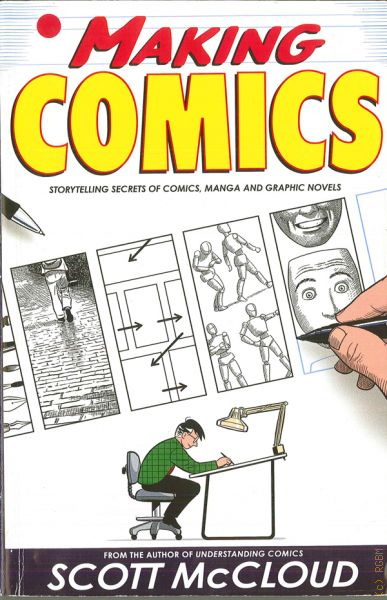
Mccloud S., Making Comics. Storytelling Secrets of Comics, Manga and Graphic Novels — 2006
Аннотация: Scott McCloud tore down the wall between high and low culture in 1993 with Understanding Comics, a massive comic book about comics, linking the medium to such diverse fields as media theory, movie criticism, and web design. In Reinventing Comics, McCloud took this to the next level, charting twelve different revolutions in how comics are generated, read, and perceived today. Now, in Making Comics, McCloud focuses his analysis on the art form itself, exploring the creation of comics, from the bro ...
![McCloud S., Reinventing comics : [how imagination and technology are revolutionizing an art form] — 2000](/searchcat/covers/RGUB-BIBL-0000774879-comi.jpg)
2000
McCloud S., Reinventing comics : [how imagination and technology are revolutionizing an art form] — 2000
Аннотация: Scott McCloud's Reinventing Comics, the sequel to his groundbreaking work Understanding Comics, is a study of two revolutions: a failed one and a potential one. His 1993 book was not only a chronicle of the potential breakthrough of comics (which he redefined as "sequential art") into a legitimate art form but a sterling example itself of the medium's astonishing untapped potential. Now, seven years later, he chronicles the failure of the comic book industry to fulfill that promise, but also explores how the movement can be restarted, particularly by utilizing the resources of another spectacularly successful revolution, the Internet. In the first half of Reinventing Comics, an elegantly clean example of comic art in McCloud's trademark bold black-and-white style, the author outlines how hype, speculation, and artistic burnout led to the genre's decline. He then lays out 12 paths toward a new revolution of comics, including creators' rights, industry innovation, public perception, gender balance, and diversity of genre, which are then explored with such innovative intelligence that, as with his earlier work, the conclusions he comes to are fascinating for both artists and nonartists alike.Three of his paths, however, are of particular interest to anyone who wants to know how the Internet will affect both our lives and the livelihoods of future artists. Understanding Comics, with its brilliant how-to guide on marrying image and language, has become an indispensable reference for many Web designers. Now McCloud returns the favor by focusing on how the digital revolution will influence production, delivery, and the art form of comics itself. Informative without being pedantic, controversial without being argumentative, and always entertaining, this is both a worthy sequel to the author's brilliant original and a work that opens up the potential for an entirely different direction for sequential art in the realm of cyberspace. --John Longenbaug
1994
McCloud S., Understanding Comics The Invisible Art — 1994
Аннотация: Understanding Comics: The Invisible Art is a 215-page non-fiction comic book, written and drawn by Scott McCloud and originally published in 1993. It explores the definition of comics, the historical development of the medium, its fundamental vocabulary, and various ways in which these elements have been used. It discusses theoretical work on comics (or sequential art) as an artform and a communications medium. It is also uses the comic medium for non-storytelling purposes.Understanding Comics received praise from notable comic and graphic novel authors such as Art Spiegelman, Will Eisner, Alan Moore, Neil Gaiman and Garry Trudeau (who reviewed the book for the New York Times), and was called —one of the most insightful books about designing graphic user interfaces ever written— by Apple Macintosh co-creator Andy Hertzfeld [1]. Although the book has prompted debate over many of McCloud—s conclusions, its discussions of —iconic— art and the concept of —closure— between panels have become common reference points in discussions of the medium.In the book's seventh chapter, "The Six Steps,"[2] McCloud outlines a six-part process of artistic creation (Idea/Purpose, Form, Idiom, Structure, Craft, Surface). He also notes that artists tend to fall into two classes, depending on which of the first two steps they emphasize more. Those who emphasize the second step "are often pioneers and revolutionaries--artists who want to shake things up,"[3] while those who emphasize the first are "great storytellers, creators who...devote all their energies to controlling their medium...to convey messages effectively."[4] With these ideas, McCloud anticipates the artistic theory of David Galenson, which divides all artists into two groups with qualities similar to those McCloud notes.
|
|




![McCloud S., Reinventing comics : [how imagination and technology are revolutionizing an art form] — 2000](/searchcat/covers/RGUB-BIBL-0000774879-comi-large.jpg)