Вход в личный кабинет         RU  EN

Поиск по каталогу печатных изданий

Простой поиск   Расширенный поиск


Автор

Заглавие

Предмет

Найдено печатных изданий: 6

Поискать книги в электронном виде


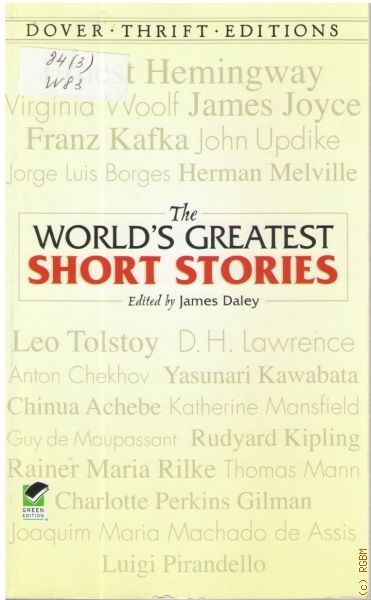
The World's Greatest Short Stories — 2006 (Dover Thrift Editions)
2006
The World's Greatest Short Stories — 2006 (Dover Thrift Editions)
2006
Mineola
Dover Publications, INC.
Аннотация: This outstanding collection features short stories by great writers from America, the United Kingdom, Ireland, and Western Europe. Ranging from the 19th to the 20th centuries, writers include Poe, Chekhov, Joyce, Kafka, Faulkner, Pirandello, Mann, and other major writers of world literature. A wonderfully wide-ranging and enjoyable anthology.
Проверяем наличие...
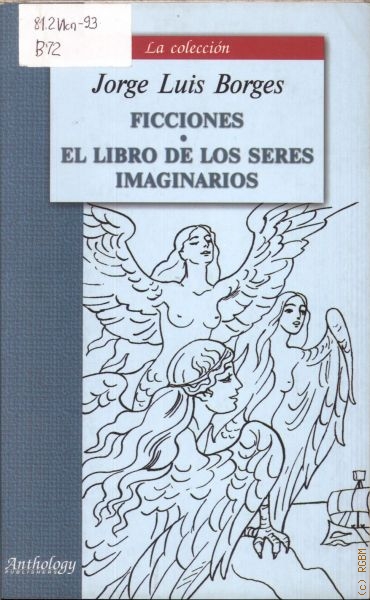
Borges J. L., Ficciones. El Libro de los Seres Imaginarios. книга для чтения на испанском языке — 2005 (La coleccion)
2005
Borges J. L., Ficciones. El Libro de los Seres Imaginarios. книга для чтения на испанском языке — 2005 (La coleccion)
2005
Санкт-Петербург
Антология
Аннотация: Книга включает сборник "Вымышленные истории" - лучшее из так называемой "фантазийной" прозы, и "Книгу вымышленных существ", написанную в традициях сочинения бестиариев, "звериных книг", начатую еще Аристотелем.
Проверяем наличие...
Borges J.L., El informe de Brodie — 2008 (Biblioteca Borges El Libro de bolsillo Biblioteca de autor)
2008
Borges J.L., El informe de Brodie — 2008 (Biblioteca Borges El Libro de bolsillo Biblioteca de autor)
2008
Madrid
Alianza editorial
Аннотация: Aunque singularice el presente volumen el predominio de la narracion directa (dejando aparte El informe de Brodie, los otros diez relatos que lo componen aceptan las convenciones del genero realista), es facil reconocer en ellos muchos de los personajes, situaciones y ambientes del resto de la obra de Jorge Luis Borges. De forma magistral y paradojica, la tecnica lineal empleada por el maestro argentino en estos cuentos no hace sino resaltar las ambiguedades y simetrias caracteristicas de las ficciones borgianas, presididas siempre por los arquetipos de la memoria, el tiempo y la eternidad
Проверяем наличие...
Borges J.L., Labyrinths. Selected Stories and Other Writings — 1981 (King Penguin)
1981
Borges J.L., Labyrinths. Selected Stories and Other Writings — 1981 (King Penguin)
1981
Harmondsworth
A King Penguin
Аннотация: Had Jorge Luis Borges been a computer scientist, he probably would've invented hypertext & the World Wide Web. Instead, being a librarian & one of the world's most widely read people, he became the leading practitioner of a densely layered imaginistic writing style that's been imitated throughout this century, but has no peer (Umberto Eco sometimes comes close). His stories are redolent with an intelligence, wealth of invention & a tight, almost mathematically formal style that challenge with mysteries & paradoxes revealed only after several readings. Highly recommended to anyone who wants their imagination & intellect to be aswarm with philosophical plots, compelling conundrums & a wealth of real & imagined literary references derived from an infinitely imaginary library.
Проверяем наличие...
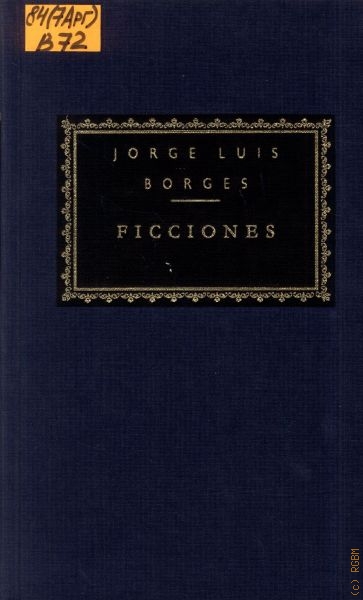
Borges J. L., FICCIONES — cop. 1993
1993
Borges J. L., FICCIONES — cop. 1993
1993
New York [etc]
Everyman`s Library
Аннотация: Reading Jorge Luis Borges is an experience akin to having the top of one's head removed for repairs. First comes the unfamiliar breeze tickling your cerebral cortex; then disorientation, even mild discomfort; and finally, the sense that the world has been irrevocably altered--and in this case, rendered infinitely more complex. First published in 1945, his Ficciones compressed several centuries' worth of philosophy and poetry into 17 tiny, unclassifiable pieces of prose. He offered up diabolical tigers, imaginary encyclopedias, ontological detective stories, and scholarly commentaries on nonexistent books, and in the process exploded all previous notions of genre. Would any of David Foster Wallace's famous footnotes be possible without Borges? Or, for that matter, the syntactical games of Perec, the metafictional pastiche of Calvino? For good or for ill, the blind Argentinian paved the way for a generation's worth of postmodern monkey business--and fiction will never be simply "fiction" again. Its enormous influence on writers aside, Ficciones has also--perhaps more importantly--changed the way that we read. Borges's Pierre Menard, for instance, undertakes the most audacious project imaginable: to create not a contemporary version of Cervantes's most famous work but the Quixote itself, word for word. This second text is "verbally identical" to the original, yet, because of its new associations, "infinitely richer"; every time we read, he suggests, we are in effect creating an entirely new text, simply by viewing it through the distorting lens of history. "A book is not an isolated being: it is a relationship, an axis of innumerable relationships," Borges once wrote in an essay about George Bernard Shaw. "All men who repeat one line of Shakespeare are William Shakespeare," he tells us in "Tlön, Uqbar, Orbis Tertius." In this spirit, Borges is not above impersonating, even quoting, himself. It is hard, exactly, to say what all of this means, at least in any of the usual ways. Borges wrote not with an ideological agenda, but with a kind of radical philosophical playfulness. Labyrinths, libraries, lotteries, doubles, dreams, mirrors, heresiarchs: these are the tokens with which he plays his ontological games. In the end, ideas themselves are less important to him than their aesthetic and imaginative possibilities. Like the idealist philosophers of Tlön, Borges does not "seek for the truth or even for verisimilitude, but rather for the astounding"; for him as for them, "metaphysics is a branch of fantastic literature."
Проверяем наличие...


Федеральное государственное бюджетное учреждение культуры
«Российская государственная библиотека для молодёжи» Главное здание 107061 Москва, ул. Б. Черкизовская, дом 4, корпус 1
Метро «Преображенская площадь» (выход №5)
Телефон для справок: +7 499 670-80-01
E-mail: info@rgub.ru

Филиал библиотеки — ИКК «Особняк В.Д. Носова» 107023 Москва, ул. Электрозаводская, 12, стр. 1
Метро «Электрозаводская»
Телефоны для справок: +7 499 670-80-01 (доб. 600)
E-mail: mansion@rgub.ru

Яндекс.Метрика

© Российская государственная библиотека для молодёжи, 2004 — 2025